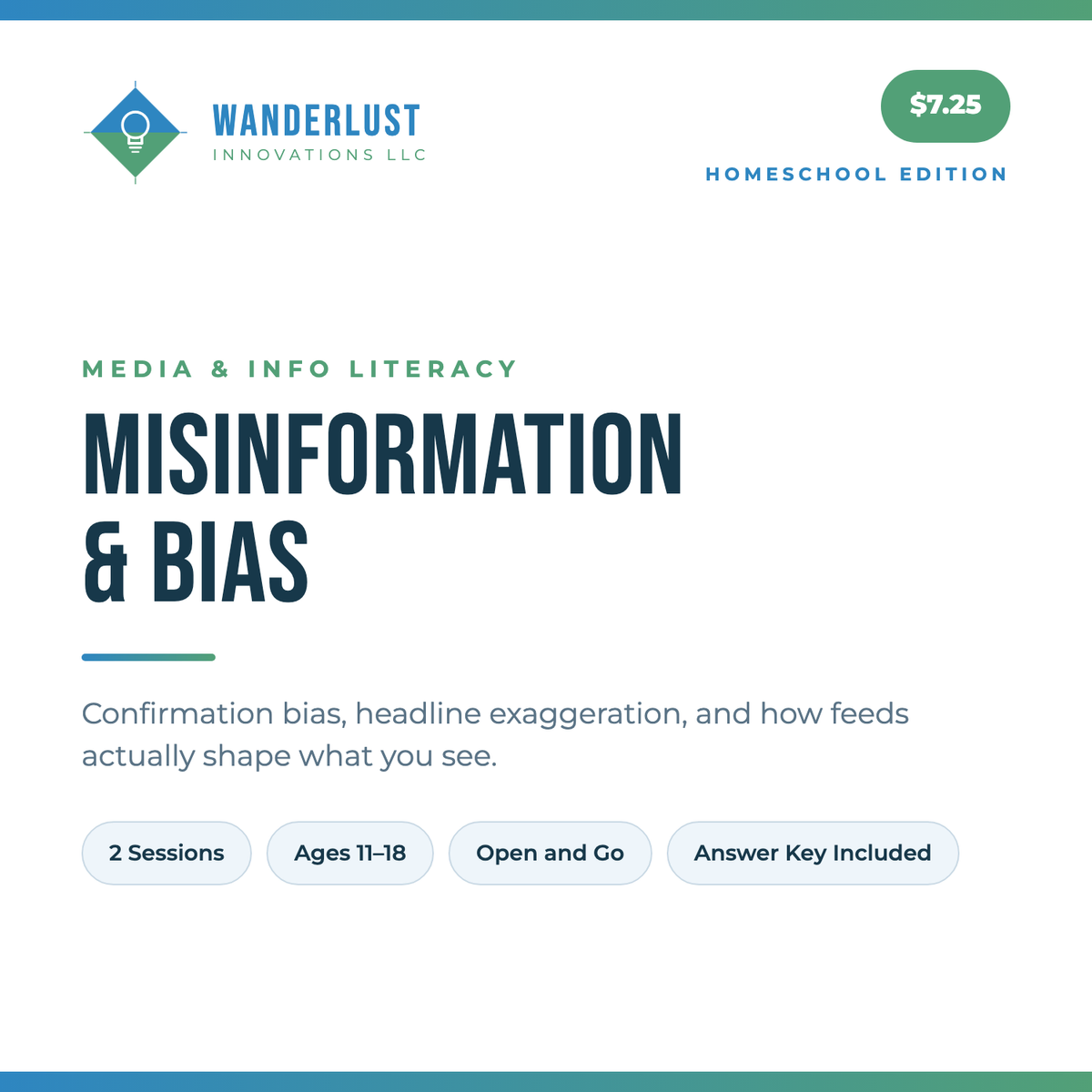
Description
Two sessions on why misinformation spreads — which turns out to be about how brains and feeds work, not about other people being gullible.
Three mechanisms, working together: confirmation bias, our own tendency to believe what matches what we already think; headline exaggeration, where a real story gets overstated into a more dramatic claim than the reporting supports; and algorithmic feeds that learn what holds attention.
The other units teach techniques for verifying a claim. This one is about what happens before anybody reaches for a technique.
Run it alongside your student rather than over their shoulder. It works on everyone.
WHAT'S INCLUDED
Written by a school media specialist with an M.S. in Instructional Technology. Built to be taught by a parent with no background in the subject.
You might also like

30 Scam & Media Literacy Warm-Ups | Homeschool Edition
The Recovery Call | Anatomy of a Scam | Homeschool Edition
The Investment | Anatomy of a Scam | Homeschool Edition